
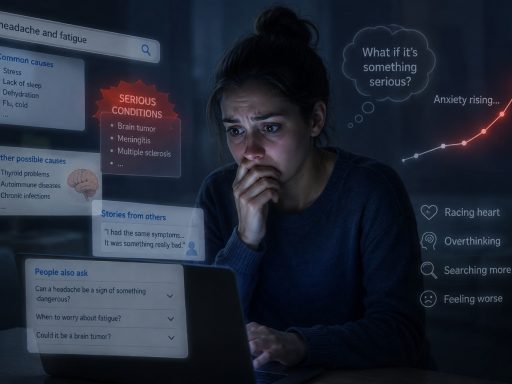
Searching for health-related information online has become an increasingly common practice.
While access to medical information can empower individuals to better understand and manage
their health, excessive online searching may also fuel worry and distress. For people with high
levels of health anxiety, searching for symptoms and illnesses on the internet can become a source
of increased concern rather than reassurance.
Understanding the Research Objectives
The study aimed to examine how individuals with high health anxiety differ from those with low
health anxiety while searching for health-related information online. In particular, the researchers
explored behavioral patterns, visual attention, emotional reactions, and physiological responses
during realistic web-search tasks.
The authors also introduced the S.E.A.R.C.H. framework (Symptom-browsing, Emotional reactivity,
Anxious motivation, Repetitive behaviour, Cognitive disengagement, and Health-centered
approach), a conceptual model designed to describe the key characteristics of maladaptive online
health searching.
Methodology: How the Study Was Conducted
Forty participants were recruited and divided into two groups according to their levels of health
anxiety. Participants completed a series of online health-search tasks in which they were asked to
identify possible diagnoses for different symptom scenarios.
To obtain a comprehensive picture of the search process, the researchers combined several
measures:
Eye-tracking technology to assess visual attention and information processing.
Pupil dilation measures as an indicator of physiological arousal.
Behavioral data, including time spent searching and number of webpages visited.
PANAS questionnaires to evaluate changes in positive and negative emotions before and
after the search tasks.
Key Findings: Searching for Reassurance, Finding Distress
The results revealed important differences between individuals with high and low health anxiety.
1. Greater Attention to Health-Related Information
Participants with high health anxiety spent more time focusing on symptom descriptions, medical
information, tables, images, and other health-related content. Eye-tracking data showed longer and
more frequent fixations on these areas, suggesting a stronger attentional bias toward potentially
threatening information.
2. Increased Emotional and Physiological Reactivity
Individuals with high health anxiety exhibited larger pupil dilation during the searches, indicating
greater physiological arousal. They also reported higher levels of negative affect after completing
the tasks, suggesting that online searches intensified emotional distress rather than reducing
uncertainty.
3. Evidence for the S.E.A.R.C.H. Framework
The findings provided support for several components of the proposed S.E.A.R.C.H. framework,
particularly symptom-focused browsing, emotional reactivity, anxious motivation, and health-
centered search behavior. Together, these processes appear to contribute to a cycle in which
online health searches reinforce anxiety rather than alleviate it.
Implications for Digital Health and Well-Being
The study highlights the complex relationship between health anxiety and online information
seeking. Although the internet offers immediate access to medical information, it may also expose
vulnerable individuals to excessive, ambiguous, or threatening content that increases distress.
Understanding how health-anxious individuals search for information online could inform the
development of digital interventions, adaptive search systems, and health-information platforms
designed to promote healthier and less anxiety-provoking search experiences.
Reference and Source
For more details, read the full article in Computers in Human Behavior Reports:
Zucchelli, M. M., Li Pira, G., Ruini, C., & Nori, R. (2026). S.E.A.R.C.H.ing for symptoms, finding
anxiety: Behavioural, ocular and affective responses in high and low health anxiety during real
online searches. Computers in Human Behavior Reports. DOI: 10.1016/j.chbr.2026.101122.